The Multifamily Roof Capex Conversation: Allocating Capital Around Insurance-Driven Decisions
A guide for multifamily owners, asset managers, and HOA boards on allocating capex around insurance compliance, code tightening, reserve correction, tenant-facing upgrades, and operational maintenance, with the structured asset-management approach Capital City Roofing uses to fix it.
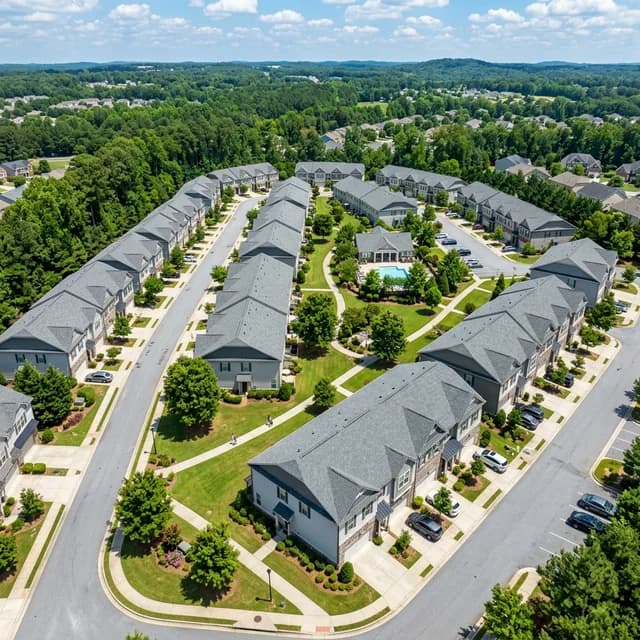
Multifamily owners are quietly stuck right now. Insurance carriers are mandating roof replacements on ninety-day windows. Georgia's 2026 code updates require Class 4 impact-resistant shingles. Reserve studies from acquisition diligence are running two to three times short on real replacement costs. And visible upgrades like windows and common areas are still pulling at the same capex dollar.
Capital City Roofing founder Brad Strawbridge said it cleanly in a Property Innovation Journal feature this month: "People are guarded with how they're allocating their capex budgets." This post is the company-side guide for asset managers who want to sequence capex intentionally rather than reactively.
The five forces pulling at the same capex dollar
Every multifamily owner I talk to right now is allocating capex against the same five competing demands:
- Insurance compliance. Carriers are dictating replacement timelines that did not exist eighteen months ago. Deductible increases of five to ten times previous levels are showing up at renewal. Non-renewals are happening on portfolios that look fine on a walking inspection but fail an aerial review.
- Code tightening. Georgia's 2026 building code updates impose stricter installation standards across the state, and Class 4 impact-resistant shingles are now a binding policy condition on many carriers.
- Reserve study correction. Replacement costs are running two to three times the underwritten number on portfolios acquired in the last five years. The number was wrong at acquisition and is more wrong now.
- Tenant-facing improvements. Windows, common areas, amenity refreshes. The visible work that drives leasing velocity.
- Operational maintenance. Routine envelope work, HVAC, life safety, the unsexy line items that protect everything else.
Owners who try to fund all five out of the operating budget end up half-funding all five. The structural items get underdone. The asset gets exposed when weather hits. The carrier moves the policy. The cycle compounds.
The "lowest bid is rarely the best bid" trap
A roof replacement is not one product. It is six or more underlying components that have to be specified, sequenced, and installed correctly. Deck condition. Underlayment selection. Fastening pattern. Flashing detail. Ventilation. Edge metal. The visible top layer is the smallest part of the decision space.
A bid that comes in twenty percent below comparable bids is almost never twenty percent better at execution. It is almost always twenty percent worse on at least one of those underlying components. The components that get cheapened are usually the ones the owner cannot see during installation. By the time the failure shows up, the warranty is voided by the install error, the contractor is out of business, and the owner is paying the full replacement cost twice.
For institutional buyers and HOA boards, the practical move is to evaluate bids on the underlying spec, not on the line item total. If the cheap bid uses a thinner underlayment, fewer fasteners, or a lower-grade flashing system, that is worth knowing before signing.
The reserve study correction problem
The reserve study problem deserves its own paragraph because it is one of the most expensive misunderstandings in the multifamily segment. The acquisition diligence team relies on the seller's reserve study. That study projects roof replacement at some year and some dollar figure. The buyer underwrites the deal accordingly. Three years later, when the buyer actually needs to price the work, the real number is two to three times the projected number.
The fix is not "get better reserve studies at acquisition." The fix is current condition data refreshed at acquisition and at regular intervals afterward. The reserve study becomes a living document. The asset manager has defensible numbers to bring to the reserve study committee, the insurance underwriter, and the capital partner.
That is the work Capital City Roofing does for institutional clients in Greater Atlanta and Nashville, built around the 100-point CCR Condition Index. Every roof in a portfolio gets a current score. Every score connects to a projected timeline and a current-dollar replacement estimate.
The Capital City Roofing capex sequencing framework
When we work with institutional and large-HOA multifamily clients, the capex conversation follows a structured sequence:
First, get current condition data. Every roof in the portfolio gets a CCR Condition Index inspection. The Index produces a score, a timeline, and a current-dollar replacement estimate. This becomes the source of truth that replaces the stale reserve study.
Second, identify the carrier-driven moves. Which roofs are at risk for non-renewal or mandatory replacement at the next insurance review. These get prioritized regardless of where they sit in the operating budget, because the cost of a non-renewal or a forced 90-day replacement is structurally larger than the cost of a scheduled replacement.
Third, identify the code-driven moves. Which roofs in the portfolio will need Class 4 impact-resistant shingles at next replacement. The cost increase per unit is real and non-negotiable. Build it into the projection.
Fourth, balance visible and structural. Visible upgrades drive leasing velocity. Structural maintenance protects everything else. Both belong in the budget. The error is treating the structural side as optional until it is forced.
Fifth, sequence everything else. Routine envelope, HVAC, life safety, and operational maintenance get sequenced against the carrier-driven and code-driven priorities. The result is a multi-year capex plan that protects the asset while working through the backlog.
How the Capital City Roofing Licensing Platform extends this
The capex framework above is not unique to our flagship operation. Every operator on the Capital City Roofing Licensing Platform inherits the same condition-assessment methodology, the same reporting framework, and the same operating system underneath. A multifamily owner working with a Capital City Roofing licensee in another market gets the same data fidelity as a multifamily owner working with us directly in Atlanta or Nashville.
The technology layer is BuilderLync, the AI-driven CRM and operating platform launching its V1 release on June 1, 2026. BuilderLync handles inspection capture, dispatch, supplements, financial management, and analytics. Combined with the CCR Condition Index methodology, the licensee delivers institutional-grade data to multifamily clients with the same fidelity Capital City Roofing delivers in our home markets.
The press features
The capex conversation in this post is the company-side response to two trade-press features that ran in the last two weeks:
- KeyCrew: Insurance Companies Now Know Your Multifamily Roof Better Than You Do
- Property Innovation Journal: Multifamily Roof Capex and Insurance-Driven Decisions
Both feature Brad Strawbridge as the primary expert source. Both cover the same structural shift from different angles: the information asymmetry between owners and carriers (KeyCrew) and the capex allocation problem this creates (Property Innovation Journal). Read both. Then come back to this post for the operator's-side playbook on what to actually do.
For Brad's longer-form first-person companion essays, see:
- Insurance Companies Now Know Your Multifamily Roof Better Than You Do
- Property Innovation Journal: The Multifamily Roof Capex Conversation
Where to go from here
For institutional and large-HOA multifamily owners in Greater Atlanta or Nashville who want a CCR Condition Index report on their portfolio, the conversation starts at brad@capitalcityroofing.net.
For roofing operators in other markets who want to deliver this caliber of multifamily asset-management work to clients in their region, the Capital City Roofing Licensing Platform is the structure for that. The conversation starts at licensing@capitalcityroofing.net. Brad reads every one of those personally.
For homeowners and smaller-portfolio property managers in Greater Atlanta and Nashville: schedule your free 27-Point Inspection or contact our team directly.
Excellence in Roofing, Powered by Innovation and Integrity.
Learn more: Multifamily Roofing Services | Capital City Roofing Licensing Platform | BuilderLync | Why Capital City Roofing | Brad Strawbridge
Brad Strawbridge
Founder & CEO · Forbes Business Council Member • RT3 & NRAP Board of Directors • GAF Master Elite® • CertainTeed ShingleMaster™ • NRCA Residential & Workforce Development Committees
Brad Strawbridge is the Founder and CEO of Capital City Roofing, bringing over a decade of hands-on expertise to the industry. He is an official member of the Forbes Business Council, the invitation-only community for vetted senior-level business leaders, and serves on the Boards of Directors of the Roofing Technology Think Tank (RT3) and the National Roofing Apprenticeship Program (NRAP). A member of the National Roofing Contractors Association (NRCA), Brad has been appointed to the NRCA Residential Roofing Committee and the NRCA Workforce Development Committee, helping set national standards for installation quality and the future of the roofing labor force. Under his leadership, Capital City Roofing has achieved elite certifications held by fewer than 1% of contractors nationwide.